


- Corrugated paper is tough and keeps things safe. It is great for shipping boxes and cartons. The special fluted layers in corrugated paper give extra padding. They help take in bumps during transport. Corrugated packaging is good for the environment and simple to recycle. Almost 90% of it gets recycled. New machines help make corrugated paper faster and better. Smart manufacturing is changing packaging. It uses more automation and cares about the planet.
Corrugated Paper Basics
Definition and Structure
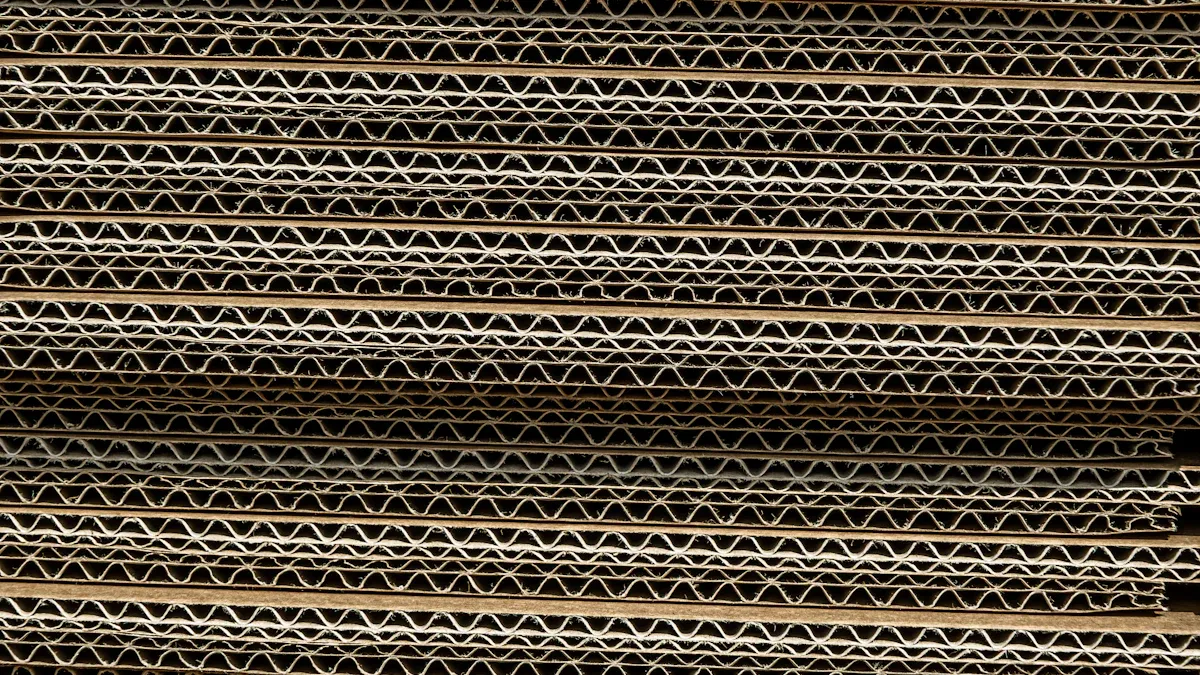
Corrugated paper is special because it has many layers. You see it in shipping boxes and cartons. A 5-ply corrugated box has five layers. There are two flat linerboards on the outside. Inside, there are three fluted paper layers. The outer linerboards help the box keep its shape. They also protect the box from damage. The fluted layers inside make air pockets. These pockets soak up bumps and shocks. This keeps your things safe when moving. Corrugated paper is stronger than regular paperboard.
Tip: The fluted layers give shipping boxes their strength and cushion.
Here is a table to compare corrugated cardboard and paperboard:
| Feature | Paperboard | Corrugated Cardboard |
|---|---|---|
| Structure | Single-layer, smooth | Multi-layer, fluted interior |
| Weight | Lightweight | Heavier and bulkier |
| Strength | Suitable for retail | More durable for shipping |
| Applications | Product packaging | Shipping boxes, protective packaging |
Corrugated cardboard is thicker and tougher than chipboard. The fluted layer inside helps the box stay strong. It also keeps its shape when stacked.
Key Properties
Corrugated paper has many good qualities for packaging:
- Strength: The layers let boxes hold heavy or fragile things.
- Cushioning: Air pockets in the fluted layers soak up shocks.
- Water Resistance: Many boxes pass the Cobb Sizing Test. This test checks how much water the paper takes in. Lower Cobb numbers mean better water resistance.
- Customizable Thickness: You can pick different flute types for your needs. For example:
| Flute Type | Thickness | Strength Characteristics |
|---|---|---|
| A Flute | 1/4″ | Great for shock absorption and cushioning. |
| C Flute | 11/64″ | Used for most boxes, balances strength and weight. |
| B Flute | 1/8″ | Resists crushing, good for folding. |
| E Flute | 1/16″ | Thinnest, good for printing but not for shipping. |
| F Flute | 1/32″ | Not for shipping, used for main packaging. |
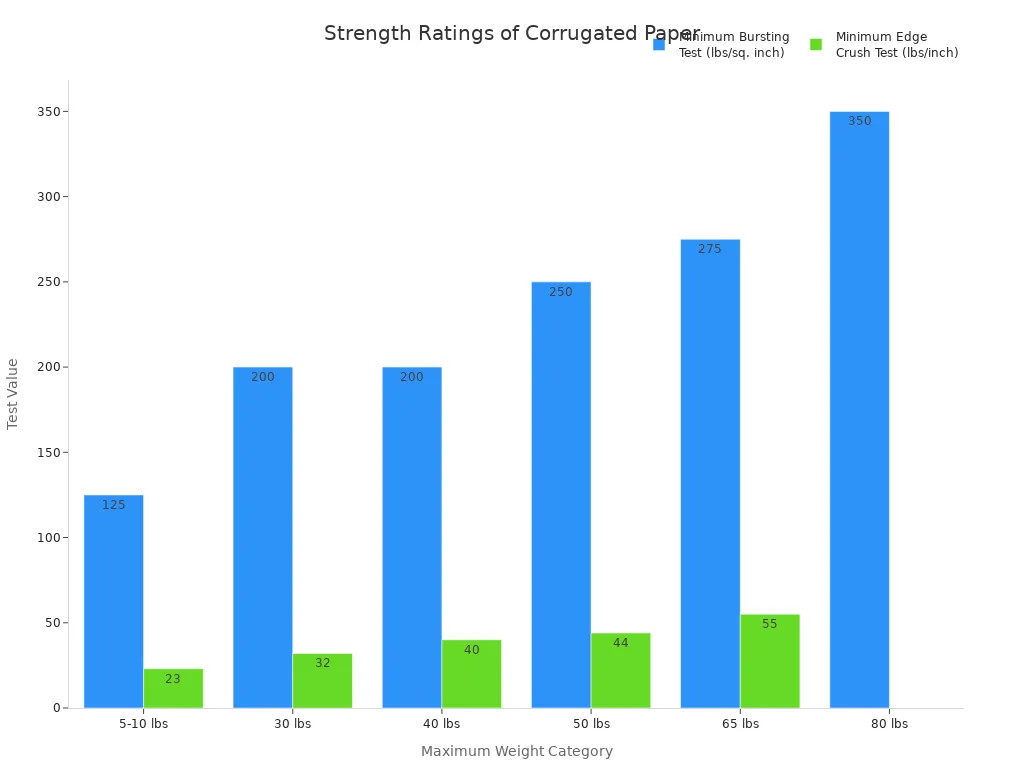
- Stacking and Edge Strength: Corrugated boxes go through tests like the Edge Crush Test and Burst Test. These tests show how much weight a box can take and how well it resists pressure.
| Test Type | Measurement | Description |
|---|---|---|
| Edge Crush Test (ECT) | Pounds per lineal inch | Shows box strength when stacked and shipped. |
| Cobb Sizing Test | Weight increase with water | Measures water resistance. |
| Grammage and Thickness | Varies | Checks box quality and padding. |
- Eco-Friendliness: Corrugated paper is easy to recycle. It is often made from recycled materials.
You can see how strong corrugated paper is at different weights in this chart:
Common Applications
Corrugated paper is used in many industries because it is strong and flexible. Some common uses are:
- E-commerce shipping boxes 📦
- Food packaging for pizza, fruits, and baked goods
- Healthcare packaging for medical supplies
- Office supply and stationery boxes
- Electronics packaging
- Marketing and printing materials
- Textile and luxury goods packaging
- Batteries and hazardous materials containers
- Army and military supply boxes
- Moving and relocation boxes
Corrugated packaging is very popular in e-commerce. In 2024, corrugated board has over 36% of the market share in this area. Companies use it because it protects products during shipping. It is also easy to recycle. Corrugated boxes keep your things safe. You can trust them when sending gifts or moving to a new home.
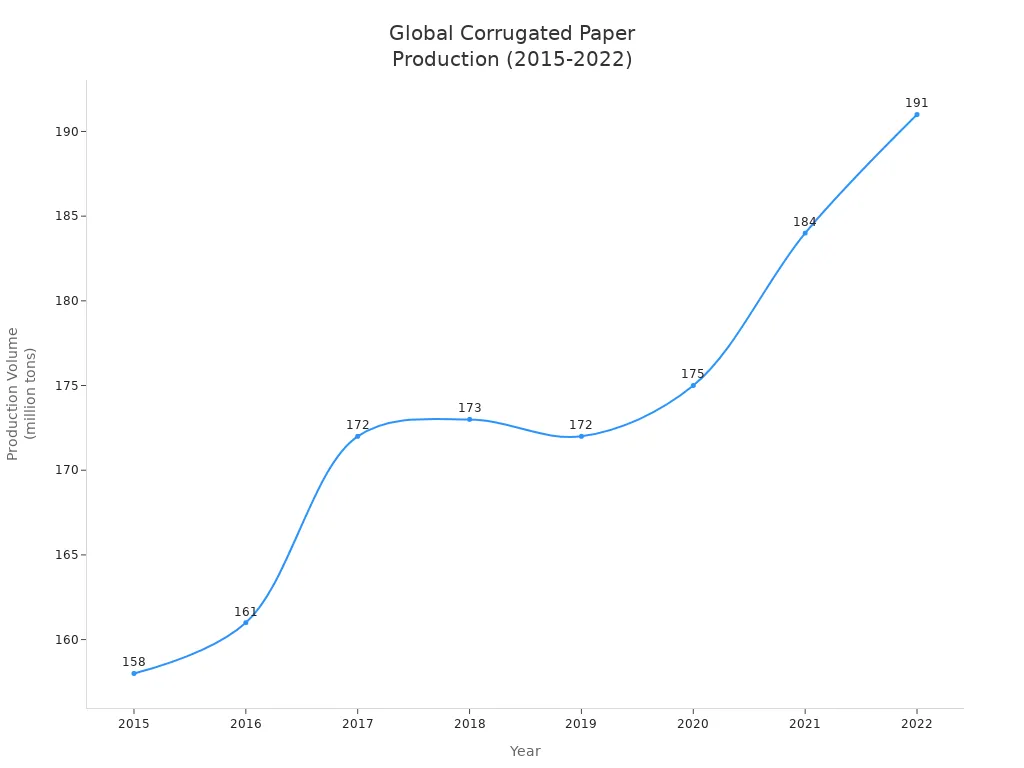
Corrugated paper has many layers, commonly found in boxes and cartons. The wavy layer in the middle provides strength and a soft cushion, protecting items during shipping. Additionally, corrugated paper effectively insulates against heat and is easy to recycle. Many companies utilize it due to its durability and eco-friendliness. A folding cartons manufacturer also relies on this material. To enhance efficiency, specialized paper packaging production equipment cuts and shapes corrugated paper quickly. As a result, global production continues to rise, as illustrated below.
Manufacturing Process
Raw Material Preparation
You need good raw materials to make strong corrugated paper. Most companies use kraft paper, test liner paper, and fluting mediums. These help boxes stay tough and last longer. You also need starch adhesives, water inks, and special coatings. These make the final product better. Here is a table that shows common raw materials and where they come from:
| Raw Material | Source |
|---|---|
| Cellulose fiber | Wood pulp from pine, fir, and cedar trees |
| Adhesives | Starch-based adhesives |
| Inks | Water-based inks |
| Coatings | Specialized coatings |
The quality of these materials changes how strong your packaging is. Kraft paper makes boxes stiff and helps them hold weight. Fluted paper soaks up bumps and stops crushing. Linerboard keeps boxes from tearing and helps them last longer.
Forming and Cutting
Machines shape and cut corrugated paper. First, you put paper rolls into the machine. Heated rollers make the paper soft. Corrugating rollers form the flutes. Glue rollers put adhesive on the fluted paper tips. Flat linerboards press onto the glued flutes. This bonds the layers together. Sharp knives cut the big sheets to the right size. Machines also crease and slot the board. This makes it easy to fold into boxes.
Here are the main steps:
- Make the flutes
- Add adhesive
- Bond the layers
- Cut to size
- Crease and slot
Modern machines work very fast. They can process up to 460 meters per minute. That is about 1,500 feet per minute. This speed helps you fill big orders quickly.
Printing and Bonding
You add pictures and words using printing methods. Flexographic printing is fast and works for most boxes. Digital printing is good for small batches and test boxes. Lithographic printing makes sharp, clear designs for fancy boxes.
Bonding is important too. Starch adhesives are safe for the environment. Synthetic adhesives make strong bonds and resist water. Hot-melt adhesives bond fast and handle heat changes. The right bonding keeps your packaging strong and dependable.
Paper Packaging Production Equipment
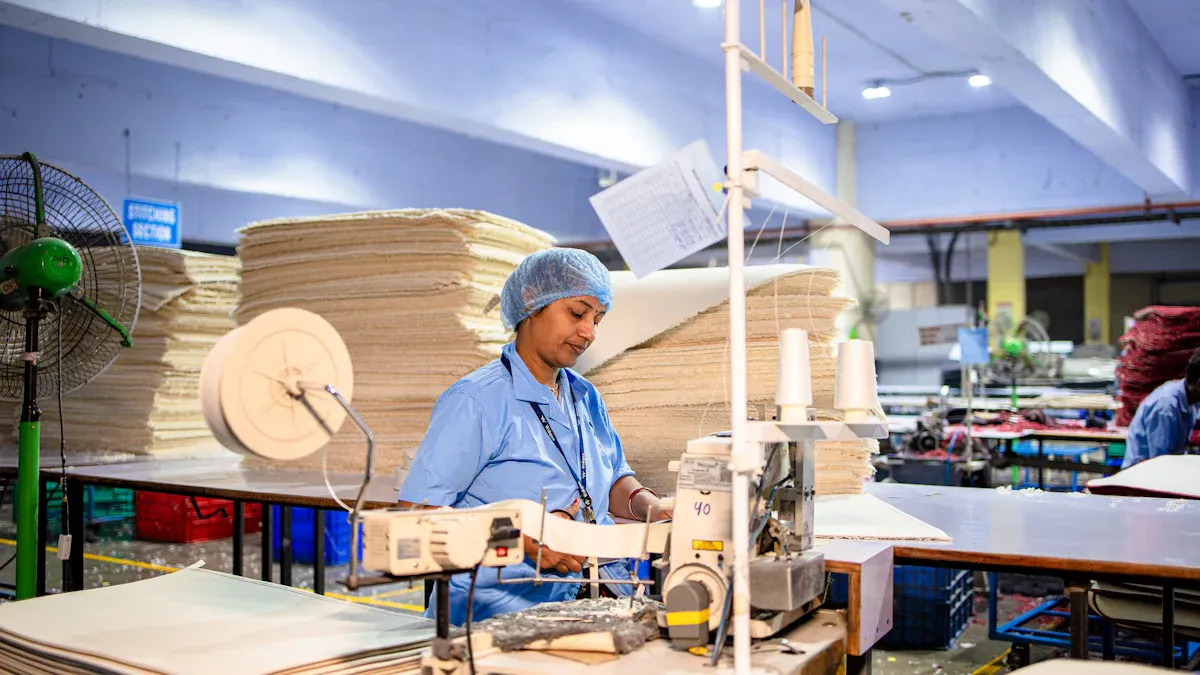
Modern packaging plants use many machines to work with corrugated paper. These machines help turn big rolls into boxes and cartons. Each machine does a special job like shaping, cutting, sealing, or checking the packaging.
Slitting and Cutting Machines
Slitting and cutting machines change large rolls into sheets. They make sure each sheet is the right size. These machines use smart systems to keep tension steady. They are very accurate and can cut sheets to match your needs. Servo motors move each part of the machine. Touchscreen controls make it easy to use.
| Feature | Specification |
|---|---|
| Tension Control | Servo-driven systems with closed-loop feedback |
| Cutting Accuracy | ±0.1mm tolerance on slit width consistency |
| Drive Systems | Individual servo motors for each section |
| Control Features | PLC-based control systems with touchscreen HMI |
| Speed Range | 200-500 meters per minute |
| Web Width | 600mm to 2500mm maximum processing width |
| Minimum Slit Width | 10-30mm depending on material and machine config |
| Roll Diameter | Unwinding up to 1500mm, rewinding up to 1000mm |
Modern slitting machines help you waste less material. They keep waste rates below 2.5%. You can trim edges as narrow as 3mm. This saves material and keeps edges neat. Special knife systems help remove trim evenly.
The YYS-IV Paper Cutting Machines by Kunshan Youyuansheng Machinery are very good. You can cut a big kraft paper roll in five minutes. These machines handle up to six rolls every hour. You can change the cutting width and diameter for each order. You use almost all the material and get smooth edges. The YYS-IV machines recycle dust, make little noise, and save energy. You get a cleaner workspace and more work done.
Tip: High-precision slitting and cutting equipment helps you reduce waste and improve edge quality, making your packaging more reliable.
Forming and Sealing Systems
Forming and sealing systems fold sheets into boxes and cartons. These machines glue and seal packaging fast and evenly. Conveyor rollers and folder gluer machines move materials through each step.
Henkel makes carton sealing solutions that are safe for food. They stick well and protect the box. You can pick systems like FasFil 1500, FasFil Jet, and FasFil Jr. for filling and sealing. Other machines add extra paper for protection.
| Product Name | Description |
|---|---|
| Automated Void Sensing System | Detects voids in packaging to optimize material usage. |
| FasFil 1500 | Efficient filling and sealing of corrugated packaging. |
| FasFil Jet | High-speed filling system for packaging operations. |
| FasFil Jr. | Compact filling system for smaller operations. |
| Paper Material Insertion System | Inserts paper materials for added protection. |
| ProPad Coiler | Coils protective paper materials in packaging. |
| ProPad System | Manages protective paper in packaging processes. |
Case and carton sealing machines make boxes strong for shipping. TECHNOMELT® hotmelt adhesives stick boxes together well. Cold seal machines close boxes without heat, which is good for sensitive items.
System Packaging is the leading supplier of Cold Seal Machines Globally.
Forming and sealing systems help boxes stay strong. Combi’s 2-EZ® HS case erectors build and seal boxes quickly. Meta® case formers use special technology to make boxes with less material but still strong. Vertical form fill seal machines work well for food and drinks. Pneumatic brakes and hydraulic stands hold materials safely and stop crushing.
Automation and Quality Control
Automation and quality control systems help keep packaging standards high. Automated vehicles move materials safely. Storage and retrieval systems make work faster. Robots help change production lines quickly.
Modern manufacturers use closed-loop systems and quality control for better results. These systems use real-time data to keep production precise and steady.
| Benefit | Description |
|---|---|
| Precision | Automation ensures precise adjustments in production parameters. |
| Consistency | Closed-loop systems maintain consistent quality across production batches. |
| Waste Reduction | Automation minimizes waste through optimized resource utilization. |
You get many benefits from advanced paper packaging production equipment:
| Benefit | Description |
|---|---|
| Increased production speeds | Control systems optimize corrugator settings in real-time, enabling machines to run faster. |
| Improved accuracy and quality | Automated systems monitor board quality, ensuring consistent production and reducing defects. |
| Reduced labor costs | Automation allows operators to focus on higher-value tasks, decreasing labor requirements. |
| Predictive maintenance | Intelligent systems predict maintenance needs, reducing unexpected downtime. |
| Real-time quality control | Continuous monitoring ensures high-quality output without manual inspections. |
| Enhanced flexibility | Quick changeovers and versatile designs allow for efficient handling of diverse production runs. |
| Maximized throughput | Automated adjustments optimize production speeds and minimize downtime. |
You use paper packaging production equipment to make every step easier. Machines like the YYS-IV Paper Cutting Machines help you work faster and use less material. You meet market needs and keep quality high while wasting less.
Trends and Innovations
Smart Manufacturing
Smart manufacturing is changing how companies make packaging. Many factories use automation to do hard jobs. These systems need little help from people. Smart packaging has RFID tags and QR codes. These help you track products and get info fast. IoT sensors check temperature, humidity, and bumps during shipping. Some machines use sensors to see if boxes stay safe. Integrated systems can automate die-cutting and printing. This makes production faster and more reliable.
- Smart packaging uses RFID tags and QR codes for tracking.
- IoT sensors watch conditions while products travel.
- Automation systems mean less manual work is needed.
- Sensors help keep products safe and check quality.
Sustainability
Sustainability is very important in packaging now. You help the earth by using renewable resources and recycling more. Many companies use managed forests that grow back after cutting trees. Paper mills make energy from leftovers, so they use less fossil fuel. Almost 90% of corrugated products get recycled. This keeps materials in use longer.
| Initiative | Description |
|---|---|
| Managed Forestry | Corrugated comes from renewable forests that are managed for timber. |
| Renewable Resources | Paper mills use energy from byproducts, with over 61% coming from renewable sources. |
| Continuous Recycling | Nearly 90% of corrugated products are reclaimed and recycled. |
Recycled materials help lower the carbon footprint for paper. The recycling rate for corrugated packaging reached 76% in 2023. This shows it is easier to recycle than other materials.
Future Directions
Big changes are coming in the next ten years. Smart packaging will use more QR codes, NFC chips, and sensors. These help with tracking and customer engagement. Companies will use only recycled materials and compostable coatings. Digital printing lets you make custom packaging for each order. This works even for small batches. Automation in box making will grow as online shopping expands. Labor costs are rising, so machines help more. New materials will make boxes lighter but still strong.
| Trend | Description |
|---|---|
| Automation | Robotics and automated systems boost efficiency and cut labor costs. |
| Sustainability | Machines use less energy and waste fewer materials. |
| Smart Manufacturing | IoT, AI, and data analytics improve how you run your factory. |
| Enhanced Efficiency | Modern machines work faster and switch jobs quickly. |
| Superior Print Quality | Advanced printing gives you better designs and more options. |
| Customization | Flexible systems handle both small and large orders easily. |
Paper packaging production equipment will be very important for these trends. These machines help you meet new needs for speed, quality, and sustainability.
Corrugated paper is changing how we package things. It gives you strong and flexible options that are good for the earth.
- Paperboard packaging keeps items safer than plastic. It can hold heavy things without breaking.
- You can use it for food boxes or shipping online orders.
- In the U.S., 68% of paperboard gets recycled. In Europe, 71% is recycled. This is much better than plastic.
Machines like the YYS-IV help you work faster and use less material. Packaging is getting smarter and better for the planet as people find new ways to protect things.
FAQ
What makes corrugated paper different from regular paper?
Corrugated paper has layers with a wavy part inside. This makes it stronger and softer than regular paper. Regular paper is flat and does not protect things well.
Can you recycle corrugated paper?
You can recycle corrugated paper very easily. Most recycling places will take it. Corrugated paper is often made from recycled stuff, so recycling helps the planet.
Why do companies use corrugated boxes for shipping?
Corrugated boxes give strong protection for shipping. The fluted layer soaks up bumps and keeps things safe. Companies pick them because they work well and save money.
How do machines like the YYS-IV help in packaging production?
Machines like the YYS-IV cut and shape corrugated paper fast. You save time and use almost all the paper. These machines also keep your workspace neat and help lower waste.
Is corrugated packaging safe for food?
Corrugated packaging is safe for food. Many food companies use it for pizza boxes, fruit trays, and bakery packs. The material keeps food fresh and stops it from getting hurt.